Your Home Deserves a Painter You Can Trust
If you’ve ever wondered, is Sheetrock and drywall the same thing, the short answer is almost. Drywall is the generic building material used to finish interior walls and ceilings, while Sheetrock is a brand name for drywall made by USG. Many people use “Sheetrock” to refer to any drywall, even though it’s actually a brand name.
Key Facts
- Drywall is the general name for gypsum wall panels used in homes and buildings.
- Sheetrock is a brand of drywall manufactured by USG.
- Every Sheetrock panel is drywall, but not every drywall panel is Sheetrock.
- Drywall comes in several types, including moisture resistant, fire rated, mold resistant and lightweight panels.
- Proper finishing requires joint tape, joint compound, sanding and primer before painting.
- Repairs work well for small damage, while larger problems may require replacing the panel.
- Whether the panel is Sheetrock or another brand, preparation and painting follow the same process.
Is Sheetrock and Drywall the Same Thing?
The confusion comes from the way people talk about building materials. Contractors, homeowners and even hardware stores sometimes use the word Sheetrock when they’re simply referring to drywall. In everyday conversation, that’s usually understood. Technically, though, the terms are not identical.
Think of it this way:
- Drywall is the product category.
- Sheetrock is one manufacturer’s version of that product.
The same relationship exists with products like Band Aid and adhesive bandages or Jacuzzi and hot tubs. The brand became so well known that many people began using it as the generic name.
For painting, repairs and finishing, the distinction usually doesn’t affect the work. The surface preparation is the same regardless of who made the panel.
What Is Drywall?
Drywall is a manufactured building panel made from a gypsum core wrapped in durable paper facing on both sides. It is fastened to wood or metal studs with drywall screws or other approved fasteners to create smooth interior walls and ceilings.
Because it installs quickly and provides a flat surface, drywall replaced traditional plaster construction in most modern homes. You may also hear drywall called:
- Gypsum board.
- Gypsum panel.
- Wallboard.
- Plasterboard.
These names describe essentially the same type of building material.
How Drywall Is Made
A standard drywall panel consists of:
- A hardened gypsum core.
- Heavy paper facing on the front.
- Protective paper backing.
- Factory formed tapered edges that make finishing easier.
The gypsum provides rigidity and fire resistance, while the paper creates a surface that accepts primer, paint and texture. Once installed, the joints between panels are covered with joint tape and drywall compound, often called drywall mud or joint compound, before being sanded smooth.
Why Drywall Became Popular
Drywall became the preferred wall finishing material because it offers several practical advantages.
Benefits include:
- Faster installation than traditional plaster.
- Smooth, consistent finish.
- Easier repairs.
- Good fire performance because of the gypsum core.
- Wide availability in different thicknesses and specialty types.
- A surface that’s ready for texture or paint after proper finishing.
These qualities make drywall suitable for nearly every room in a home.
What Is Sheetrock?
Sheetrock is a registered brand of drywall produced by USG, one of the best known manufacturers of gypsum products in North America.
The panels are still gypsum board. The difference is simply the company that makes them. Many other manufacturers also produce drywall panels that perform similarly when installed correctly.
From a contractor’s perspective, a wall built with Sheetrock and a wall built with another quality drywall brand are prepared, finished, primed and painted using the same professional methods.
Is Sheetrock Better Than Drywall?
This question comes up often, but it compares a brand with a product category. A more accurate comparison would be:
- Sheetrock vs. another drywall brand.
- One manufacturer’s moisture resistant panel vs. another’s.
- One fire rated panel vs. another’s.
Quality differences between manufacturers can exist, but they depend on the specific product rather than the name Sheetrock itself. For most homeowners, choosing the right type of drywall is more important than choosing a particular brand.
Book Your Free Estimate Today!
Ready to transform your space? Our team is here to help you get started with a no-obligation, on-site estimate. Whether it’s a quick refresh or a full makeover, we’ll guide you every step of the way.
The History of the Sheetrock Brand
Before drywall became common, interior walls were usually finished with wood lath covered in several coats of plaster. While durable, plaster required skilled labor and considerable drying time.
During the early 1900s, manufacturers developed gypsum wall panels as a faster alternative. USG introduced the Sheetrock brand, which became widely adopted as residential construction expanded throughout the United States.
Builders appreciated several advantages:
- Faster installation.
- Reduced labor.
- Consistent panel sizes.
- Less drying time.
- Easier remodeling and repairs.
As more homes were built with gypsum panels, the Sheetrock name became familiar to contractors and homeowners alike. Over time, many people began using the brand name to describe any drywall panel, even if it was made by another manufacturer.
Why Do People Call Drywall “Sheetrock”?
This is mostly a matter of habit. Someone renovating an older home may say: “We’re replacing the Sheetrock.”
Even if the replacement panels come from a completely different manufacturer. The same happens with many household products where one brand became especially recognizable.
For professionals, using the correct terminology helps avoid confusion when ordering materials or discussing specifications. For everyday conversation, most people understand what is meant either way.
Sheetrock vs. Drywall
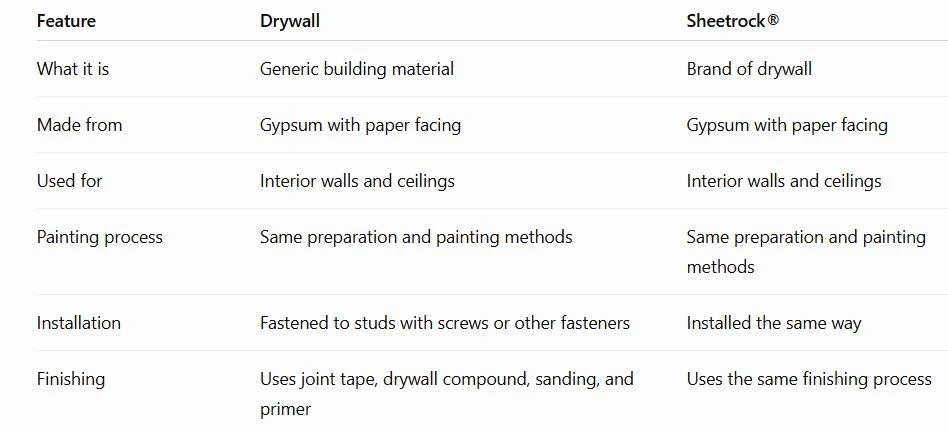
The biggest takeaway is simple: Sheetrock is drywall, but drywall is not always Sheetrock.
Book Your Free Estimate Today!
Ready to transform your space? Our team is here to help you get started with a no-obligation, on-site estimate. Whether it’s a quick refresh or a full makeover, we’ll guide you every step of the way.
What's Inside a Drywall Panel?
Although drywall looks simple from the outside, several components work together to create a durable finished wall. A typical panel includes:
- Gypsum core for strength and fire resistance.
- Paper facing that supports paint adhesion.
- Paper backing to protect the rear surface.
- Factory tapered edges that make it easier to conceal joints with compound.
- A surface designed to accept primer, paint, texture or a skim coat after proper finishing.
Once the panels are secured to the framing, installers cover the seams with joint tape embedded in drywall compound. Additional coats of compound are applied, feathered outward and sanded smooth until the joints blend into the surrounding surface.
This finishing process is what transforms individual panels into walls that appear seamless after painting.
Does It Matter If You Paint Sheetrock or Drywall?
From a painter’s perspective, the brand printed on the back of the panel isn’t what determines the quality of the finished wall.
What matters is whether the drywall was:
- Installed correctly.
- Finished smoothly.
- Properly sanded.
- Free of dust before priming.
- Primed with a quality drywall primer.
- Painted with products appropriate for the room.
Whether we’re preparing newly installed gypsum board or repairing existing interior walls before repainting, the same attention to surface preparation produces the best results. That’s why experienced contractors, including the team at Pro A&M Painting, focus on proper drywall finishing and paint preparation rather than the brand name stamped on the panel.
Different Types of Drywall
Not all drywall panels are the same. Manufacturers produce specialty products for specific rooms and building requirements. Choosing the right panel helps the finished wall last longer and perform as intended.
1. Standard Drywall
Standard drywall is the most common choice for living rooms, bedrooms, hallways and other dry interior spaces. It has a gypsum core with paper facing and is available in several thicknesses. Most residential walls use 1/2-inch panels, while ceilings or areas needing extra strength may use thicker material.
Best for:
- Living rooms.
- Bedrooms.
- Dining rooms.
- Hallways.
- Home offices.
2. Moisture Resistant Drywall (Green Board)
Green board is designed for areas with higher humidity than the rest of the home. It has a moisture resistant facing that helps reduce water absorption compared to standard drywall. It’s important to remember that moisture resistant drywall is not waterproof. It should not be used where it will have direct or continuous contact with water.
Common uses include:
- Laundry rooms.
- Powder rooms.
- Finished basements with controlled humidity.
- Bathroom walls outside the shower enclosure.
3. Mold Resistant Drywall
Mold resistant drywall is manufactured with materials that make it less likely to support mold growth when exposed to occasional moisture. Many products replace traditional paper facing with fiberglass or specially treated materials that don’t provide mold with an easy food source.
This type of drywall can be a good choice for:
- Bathrooms.
- Utility rooms.
- Basements.
- Areas with higher humidity.
It still requires proper ventilation and moisture control. No drywall product can solve an ongoing leak or water intrusion problem.
4. Fire Rated Drywall (Type X Drywall)
Type X drywall contains special additives in its gypsum core that improve fire resistance. Building codes commonly require it in locations such as:
- Attached garages.
- Shared walls between townhomes.
- Utility spaces.
- Certain ceilings and structural assemblies.
Although it looks similar to regular drywall, Type X panels are engineered to provide additional fire protection as part of a tested wall or ceiling system.
5. Lightweight Drywall
Lightweight drywall offers the same basic function as traditional gypsum board while reducing panel weight. Contractors often appreciate it because it’s easier to carry, lift and install, especially on ceilings.
Benefits include:
- Easier handling.
- Reduced installer fatigue.
- Good strength for residential applications.
- Simpler transportation.
Once installed and finished, homeowners usually cannot tell the difference by appearance alone.
Book Your Free Estimate Today!
Ready to transform your space? Our team is here to help you get started with a no-obligation, on-site estimate. Whether it’s a quick refresh or a full makeover, we’ll guide you every step of the way.
How Drywall Finishing Creates Smooth Walls
Installing drywall panels is only the beginning. The finished appearance depends on careful drywall finishing, which hides the seams, screw heads and joints until the entire wall looks like one continuous surface. Skipping steps or rushing this process almost always shows up after paint is applied.
Step 1: Tape the Joints
After the panels are secured to the studs, installers cover every seam with joint tape. The tape reinforces the joint and helps prevent cracks from developing as the home naturally expands and contracts. Both paper tape and fiberglass mesh tape are commonly used, depending on the application.
Step 2: Apply Joint Compound
Next comes joint compound, often called drywall mud. Several thin coats are applied rather than one thick layer. Each coat extends slightly wider than the previous one so the transition becomes nearly invisible after sanding. Professionals avoid applying excessive compound because thicker applications take longer to dry and are more likely to shrink or crack.
Step 3: Sand the Surface
Once the compound dries, it’s sanded smooth. The goal isn’t simply to remove excess material. The objective is to blend repaired areas seamlessly into the surrounding wall. Good lighting often reveals imperfections that aren’t obvious under normal room lighting, which is why experienced finishers frequently inspect walls from multiple angles.
Step 4: Apply a Skim Coat When Needed
Some walls require a skim coat, which is a thin layer of drywall compound spread across a larger area. A skim coat helps: Hide previous repairs. Improve uneven surfaces. Reduce minor texture differences. Prepare older walls for repainting. This step takes patience, but it can dramatically improve the final appearance.
Why Primer Matters Before Painting Drywall
Fresh drywall and drywall compound absorb paint differently. Without primer, those differences often become visible after the finish coat dries. That’s why professional painters rarely skip this step. A quality drywall primer helps:
- Seal porous surfaces.
- Create even paint absorption.
- Improve paint adhesion.
- Reduce flashing between repairs and existing walls.
- Produce a more uniform finish.
Applying finish paint directly over new drywall usually leads to uneven sheen and inconsistent color.
Book Your Free Estimate Today!
Ready to transform your space? Our team is here to help you get started with a no-obligation, on-site estimate. Whether it’s a quick refresh or a full makeover, we’ll guide you every step of the way.
Can Sheetrock and Drywall Be Painted the Same Way?
Yes. Whether the panel comes from USG or another manufacturer, the painting process is essentially the same. A professional paint job generally follows this sequence:
- Inspect the finished surface.
- Sand any remaining imperfections.
- Remove all sanding dust.
- Spot repair small flaws if necessary.
- Prime the entire surface.
- Apply two finish coats of quality interior paint.
The brand of drywall doesn’t change these steps.
Common Myths About Sheetrock and Drywall
There are plenty of misconceptions about drywall and the Sheetrock brand. Here are some of the most common ones and the facts behind them.
1. Sheetrock and Drywall Are Different Materials
- They are made from the same basic material. Drywall is the generic name for gypsum board, while Sheetrock is a brand of drywall manufactured by USG. Every Sheetrock panel is drywall, but not every drywall panel is Sheetrock.
2. Sheetrock Is Always Better Than Other Drywall Brands
- Not necessarily. Reputable manufacturers produce drywall that meets industry standards for residential and commercial construction. Performance depends more on choosing the right type of drywall, such as standard, moisture resistant or Type X, than on the brand name.
3. Only Sheetrock Can Be Painted
- Any properly installed and finished drywall can be primed and painted. Whether the panel is Sheetrock or another brand, the surface preparation, primer and paint application are the same.
4. All Drywall Is the Same
- Drywall is available in several types for different applications. Standard drywall, green board, mold resistant drywall, blue board and Type X drywall are all designed to meet specific performance requirements.
5. You Can Tell the Brand After the Wall Is Finished
- Once drywall has been taped, finished, primed, and painted, it’s almost impossible to identify the manufacturer by looking at the wall. Brand markings are typically printed on the back of the panel and are no longer visible after installation.
Conclusion
So, is Sheetrock and drywall the same thing? Not exactly, but they’re closely related. Drywall is the general name for gypsum wall panels used to build interior walls and ceilings. Sheetrock is simply one well known brand of drywall. The distinction matters when discussing manufacturers, but for most homeowners, both materials are installed, finished, primed, repaired and painted using the same professional methods.
The biggest factors affecting the quality of a finished wall aren’t the brand printed on the panel. Proper installation, careful drywall finishing, thorough surface preparation, quality primer and the right paint all have a much greater impact on the final result.
Whether you’re repairing a small hole, renovating an older room, or preparing newly installed drywall for paint, understanding these basics will help you make better decisions and achieve longer lasting results.