Your Home Deserves a Painter You Can Trust

Can I paint Trex decking? Yes, some older Trex composite boards can be painted, but newer capped Trex decking should not be painted or stained on its walking surface. The right answer depends on the product line, its protective surface and the manufacturer’s guidance for that specific board.
TL;DR
- Newer capped Trex decking: Painting or staining the walking surface is not recommended and may affect the limited residential fade and stain warranty.
- Older uncapped Trex decking: Certain early generation products can be painted or stained, provided the coating is suitable for a walking surface and manufacturer guidance is followed.
- Paint adhesion matters: A coating that initially sticks may still wear, peel or become difficult to maintain under outdoor exposure and foot traffic.
- Cleaning comes first: Fading, dirt, mold and stains may be addressed with manufacturer approved cleaning methods rather than paint.
- Check before starting: Identify your decking model and review its current care instructions and warranty before applying any coating.
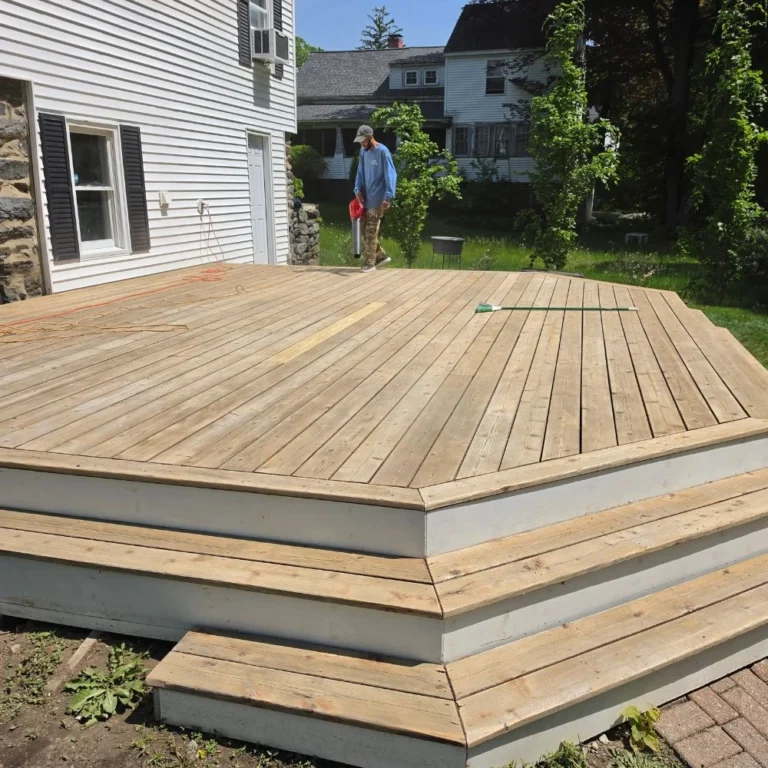
The most important distinction is between early generation composite decking and newer products with a protective outer shell.
Trex introduced its high performance shell technology in 2010 and discontinued early generation composite decking in 2014. The newer boards have a protective layer that wraps around three sides of the composite core. That surface is engineered to provide resistance to fading, staining, scratches and other outdoor wear. Trex does not recommend painting or staining the walking surfaces of its current high performance decking lines.
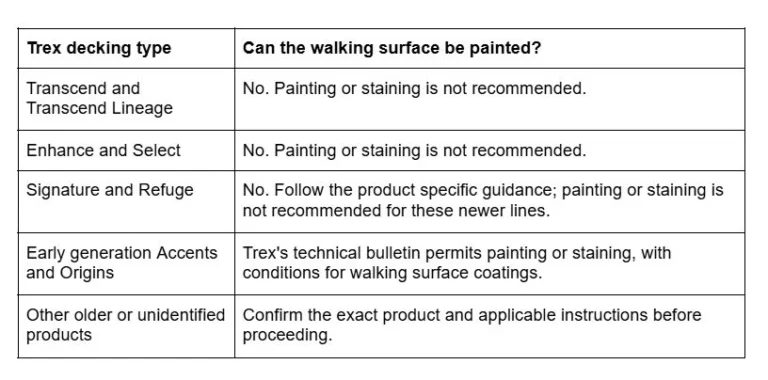
The product names above are important because advice that applies to an older composite board may be unsuitable for a modern capped board.
The practical rule: Do not choose an exterior deck paint just because its label says it works on composite decking. First, check whether the manufacturer allows painting or coating the specific Trex product you own.
Why Trex Decking Is Different From Wood
Traditional wood decking and composite decking may look similar, but their surfaces behave differently when exposed to paint.
Composite boards have a different surface structure
Trex composite decking is made from a mixture of recycled and reclaimed materials, including wood fibers and plastic. Newer generation products add a protective outer shell around the composite core. The color and surface finish are engineered into this shell rather than relying on a conventional paint film applied after installation.
On bare wood, suitable exterior paint can penetrate the surface to some extent, depending on the species, condition, primer and coating system. On capped composite decking, the outer shell is not bare wood. Paint must bond to the existing manufactured surface and that surface was not designed to require a field applied finish.
The result is a potential mismatch between the coating and the substrate. Even if paint appears to adhere initially, its long term performance on an unapproved surface is not assured.
Exterior exposure creates additional challenges
Deck boards experience more than rain and sunshine. They are exposed to:
- Repeated foot traffic and friction from shoes, furniture and outdoor equipment.
- Standing water, dirt, pollen and organic debris.
- Expansion and contraction as temperatures change.
- Ultraviolet radiation that can affect exposed coatings.
- Frequent cleaning, which may gradually wear an unsuitable finish.
An exterior paint can be formulated to withstand weather and still be unsuitable for a particular composite surface. Product compatibility, adhesion, flexibility, abrasion resistance and the intended use of the coating all matter.
A paint film can change the maintenance requirements
One reason homeowners choose composite decking is to avoid the recurring sanding, painting and staining commonly associated with wood decks.
Adding paint introduces a separate finish that must be maintained. If the coating wears unevenly or begins peeling, restoring a consistent appearance may require removing or repairing the finish. On a capped Trex board, that creates an additional problem because the manufacturer advises against sanding the decking surface.
For these reasons, the fact that a paint manufacturer offers a product for composite decking does not override Trex’s instructions for its own products.
Book Your Free Estimate Today!
Ready to transform your space? Our team is here to help you get started with a no-obligation, on-site estimate. Whether it’s a quick refresh or a full makeover, we’ll guide you every step of the way.
Can You Paint Older Trex Decking?
Older Trex boards require a more specific assessment because early generation products differ from modern capped decking.
Trex’s painting technical bulletin identifies early generation products such as Trex Accents and Trex Origins as products that may be painted or stained. It states that suitable exterior paints or stains intended for wood can be used on these older products, subject to the applicable product instructions. For walking surfaces, Trex specifies a coating designed for that use and advises confirming compliance with accessibility requirements before application.
What does uncapped composite decking mean?
Uncapped composite decking does not have the same protective outer shell found on newer high performance Trex products. Its surface is more exposed to weathering, so older boards may show more visible fading, staining, or surface wear over time.
Early generation Trex was designed to require less maintenance than wood, but it could still fade and develop surface marks. Trex notes that these earlier boards differ from newer products in their resistance to stains, scratches, and mold.
The absence of a protective shell can make a suitable coating a possible option under the manufacturer’s guidance. However, the board’s condition still matters. Crumbling material, deep damage, excessive wear or underlying structural problems cannot be corrected by applying paint.
What about older Trex that has already faded?
Fading alone does not necessarily mean a board needs a new coating. Trex acknowledges that early generation composite decking can change color as it weathers. Before painting, determine whether the change is normal weathering, embedded dirt, staining or actual surface deterioration.
If the boards are otherwise sound and the exact product is confirmed as paintable, a coating designed for exterior walking surfaces may be an option. Follow the manufacturer’s preparation instructions and confirm that the proposed finish is compatible with the deck material.
Do not transfer this advice to newer capped boards simply because they are old. A Transcend, Enhance or Select deck remains a product with a protective shell even after years outdoors.
What Happens If You Paint Trex Decking?
The outcome depends on the product, coating, surface condition, exposure and maintenance. Not every painted board will fail immediately, but there are several practical risks to consider before proceeding.
1. The paint may not adhere reliably
Paint adhesion describes how well a coating bonds to the surface beneath it. A coating may look satisfactory after application but fail later if the substrate is incompatible or the surface was not prepared according to the relevant instructions.
Capped composite boards present a particular concern because their protective shell is not intended to receive a conventional field applied paint finish.
Cleaning away dirt does not make an otherwise prohibited coating application acceptable. Nor does using a primer automatically make paint compatible with a Trex walking surface.
2. Peeling and wear may create an uneven appearance
A deck is a high traffic horizontal surface. Unlike painted siding, its finish is repeatedly rubbed by shoes, furniture, planters and other objects.
If a coating loses adhesion or wears through in frequently used areas, the result can be a patchy appearance. Edges, stair treads, board ends and areas exposed to standing moisture may also behave differently from more sheltered sections.
Once a coating starts failing, spot repairs may be noticeable because the new paint may not match the weathered finish. Recoating can also become complicated if the existing paint is incompatible with the next product.
These are risks rather than guaranteed outcomes, but they are important when weighing the convenience of changing the color against the possibility of ongoing maintenance.
3. The surface may become more difficult to maintain
Trex’s current capped decking is designed to be maintained using approved cleaning methods rather than a conventional paint finish.
If paint is applied, cleaning products and techniques suitable for the original decking may not be suitable for the added coating. Conversely, cleaners selected to preserve the paint might not be recommended for the composite material.
This creates two sets of maintenance requirements. The homeowner must consider both the original deck surface and the coating manufacturer’s instructions.
4. Sanding is not a safe default solution
On traditional wood deck, sanding may be part of preparing a worn painted surface for refinishing. That approach should not be transferred automatically to Trex.
Trex explicitly advises against sanding its decking because doing so can compromise the surface’s appearance and protective properties. The manufacturer also warns that sanding can affect warranty coverage for problems attributable to the alteration.
If a painted Trex surface starts peeling, do not assume that sanding the entire deck is the appropriate repair. First identify the product and determine which corrective options are compatible with its construction.
5. Painting can affect warranty protection
Warranty implications are a major reason to check the product documentation before making changes. Trex does not recommend painting or staining its high performance decking, as doing so may void the limited residential fade and stain warranty. Its warranty documents also contain exclusions for paint and other coatings applied to covered products. The specific terms depend on the product and applicable warranty.
It would be inaccurate to conclude that every Trex product automatically loses every form of warranty protection under identical conditions. Instead, distinguish between the warranty coverage affected by the coating and other coverage that may be governed by different terms.
Before proceeding, check the warranty supplied with your deck, confirm which version applies and ask Trex to clarify any uncertainty in writing. If warranty coverage is important to you, do not treat painting as a reversible experiment.
Book Your Free Estimate Today!
Ready to transform your space? Our team is here to help you get started with a no-obligation, on-site estimate. Whether it’s a quick refresh or a full makeover, we’ll guide you every step of the way.
What Should You Do Instead of Painting Trex?
If your goal is to improve the appearance of a Trex deck, begin by identifying the actual problem. Dirt, mildew, fading, discoloration, scratches and damaged boards call for different responses.
Clean the deck before deciding it needs refinishing
A deck that looks dull or uneven may have accumulated dirt, pollen, food residue or organic debris. Cleaning the surface may improve its appearance without adding a coating.
Trex provides separate care guidance for newer high performance decking and early generation composite products. Its current guidance generally recommends soap and water for newer lines, while early generation products may require a suitable composite deck cleaner. Always check the instructions for your particular product before selecting a cleaner. A sensible approach is to:
- Remove furniture, planters, loose leaves and other debris.
- Identify the board type and consult the matching care guide.
- Test any permitted cleaning product in an inconspicuous area if the instructions call for it.
- Use the recommended brush, cleaning solution and rinsing method.
- Allow the deck to dry and assess the result before considering further work.
Avoid aggressive scrubbing, unapproved solvents or improvised chemical mixtures. A cleaner that removes a stain from one surface may discolor or damage another.
Trex also cautions against pressure washing early generation decking because it can damage the surface. Do not assume that pressure washing instructions for a newer product apply to older boards.
Address mold and mildew using approved methods
Dark marks may be associated with mold, mildew or organic buildup rather than permanent discoloration. Trex recommends regular cleaning to prevent the buildup of pollen and debris that can support mold growth.
Follow the manufacturer’s mold cleaning guidance for your decking line. If the marks persist after appropriate cleaning, determine whether they are surface staining, deeper discoloration or signs of material damage before trying a stronger product.
Painting over a stain without identifying its cause can conceal the visible symptom without resolving the underlying issue.
Understand the difference between fading and damage
A change in color does not automatically indicate a defect. Older composite decking may weather and fade naturally, while newer capped products are engineered for improved color retention.
Scratches and scuffs also require careful assessment. Trex provides specific cleaning advice for some surface marks and certain scuffs or abrasions may become less noticeable through natural weathering. Other damage may remain visible or require a different solution. Do not sand or apply a generic deck stain simply because the original color has changed.
Consider replacing individual boards
If a small number of boards are cracked, severely damaged or noticeably different in condition from the rest of the deck, replacement may be more appropriate than coating the entire surface.
Before replacing boards, confirm the product line, board profile, color, dimensions and fastening requirements. Older Trex colors or profiles may no longer be available, so an exact match is not guaranteed.
A replacement may look different from weathered surrounding boards, even when the new board belongs to the same product line. Assess the overall appearance before committing to a larger repair.
Consider changing the deck’s appearance without coating the boards
If the boards are structurally sound but you want a different overall look, you have alternatives that do not involve painting the walking surface. Options may include:
- Updating compatible outdoor furniture, cushions and planters.
- Changing railing or other separate components where the relevant manufacturer permits refinishing.
- Improving the appearance of the surrounding landscaping or exterior finishes.
- Replacing the decking when a substantially different board color or style is essential.
These options will not change the boards themselves, but they can alter the appearance of the overall space without introducing an unapproved finish to the deck surface.
Book Your Free Estimate Today!
Ready to transform your space? Our team is here to help you get started with a no-obligation, on-site estimate. Whether it’s a quick refresh or a full makeover, we’ll guide you every step of the way.
How to Determine Whether Your Trex Deck Can Be Painted
Before buying paint, take a few minutes to establish exactly what is installed. This is more reliable than judging the board’s age or appearance alone.
1. Look for product information
Check any remaining installation paperwork, original invoices, product labels or records from the previous homeowner or deck contractor.
Look for the collection name, such as Transcend, Enhance, Select, Accents or Origins. If the records identify a newer capped product, do not paint its walking surface.
If the deck was installed many years ago, that information can help narrow down the possibilities, but installation date alone does not confirm the product.
2. Compare the boards with Trex’s product information
Trex explains the differences between early generation and newer generation decking in its official FAQ. Older product lines include Accents, Origins, Profiles, Brasilia and Contours. Newer high performance lines have a protective shell around three sides of the board.
Visual appearance can provide clues, but it should not be the only basis for deciding whether a coating is permitted. Colors, surface textures, weathering and replacement boards can make identification less straightforward.
3. Read the official painting bulletin
Use the Trex Painting and Staining Technical Bulletin to check the guidance for the identified product. The bulletin distinguishes newer Transcend, Enhance and Select decking from early generation products. It also states that painting the ends or undersides of certain newer boards is permitted, provided paint is kept off the top surface. Follow the current product specific instructions if they differ from older documentation.
4. Confirm the applicable warranty
Review the official Trex warranty information and determine which warranty applies to your installation. Check the specific language covering paint, stains, coatings, surface damage and changes to the product. If you cannot determine whether a proposed treatment is allowed, contact Trex customer support before proceeding.
The Trex care and cleaning guide is also useful when the actual problem is dirt, mildew, staining or weathering rather than a need to change the deck color.
5. Get professional advice when the surface or product is uncertain
Professional input can help when the deck has multiple board types, previous coatings, extensive discoloration or signs of deterioration. A qualified painting contractor can assess the visible condition and help you understand which options are realistic, but should not substitute a paint manufacturer’s general advice for Trex’s product specific restrictions.
Conclusion
The answer to can I paint Trex decking depends on which Trex product you own. For newer capped boards, painting or staining the walking surface is not recommended and doing so may affect warranty protection. Some older, uncapped products can be painted or stained under the manufacturer’s stated conditions. Before making a decision:
- Identify the decking product rather than relying on its age alone.
- Clean the surface using the appropriate Trex care instructions.
- Review the painting bulletin and warranty that apply to your product.
- Consider replacement or other appearance updates if painting is not permitted.
- Avoid sanding, aggressive preparation or an unapproved coating in an attempt to force paint to adhere.
If the boards are older, the product is unidentified or discoloration persists after cleaning, get product specific guidance before spending money on a coating.
Pro A&M Painting can discuss your deck’s visible condition and potential exterior painting needs in Massachusetts. The appropriate next step is to establish what material you have and which treatments are permitted, so the decision protects the existing surface rather than creating a new maintenance problem.