Your Home Deserves a Painter You Can Trust
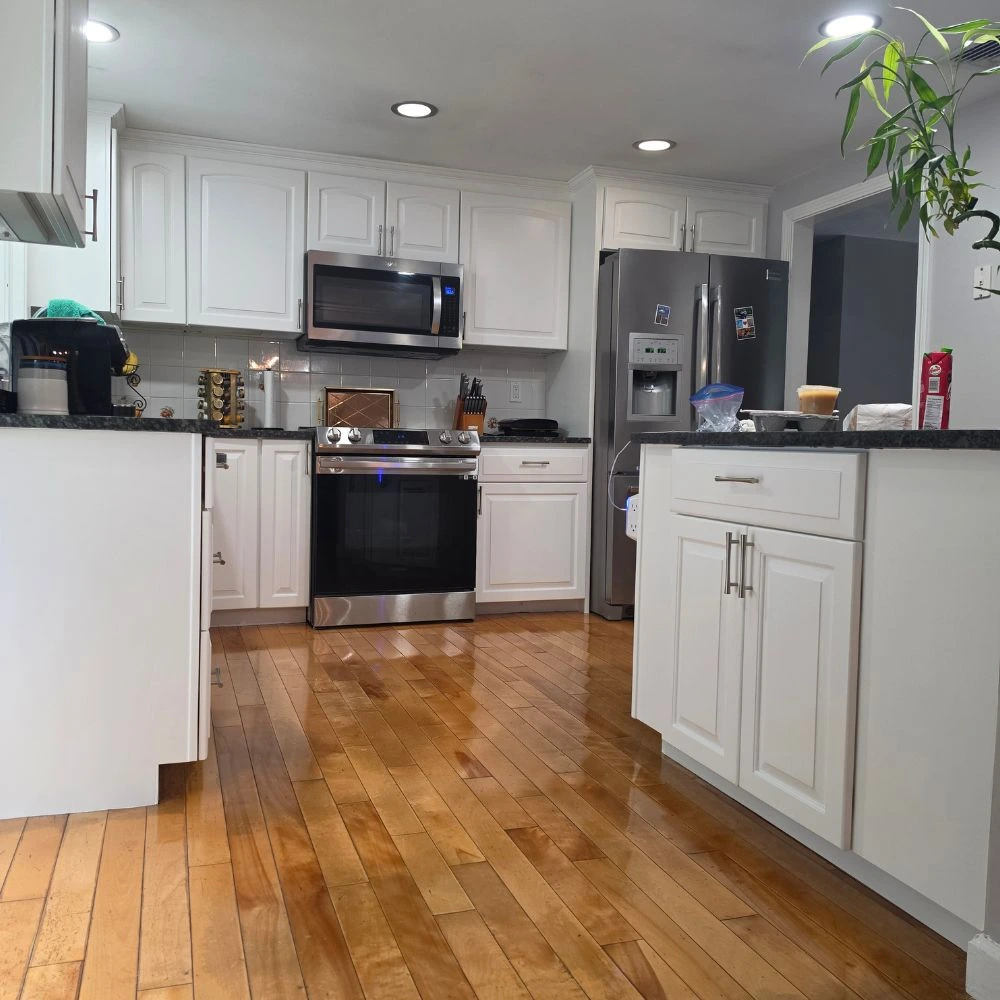
The best paint for kitchen cabinets without sanding is usually a durable cabinet and trim enamel paired with a compatible bonding primer. The right combination depends on the existing finish, surface condition and product instructions. You can often avoid extensive sanding, but you should still remove grease, prepare the surface and confirm that the primer and paint will adhere properly.
TL;DR
- Best overall approach: Clean the cabinets thoroughly, apply a bonding primer approved for the existing surface and finish with a durable cabinet enamel.
- Best for previously painted cabinets: A cabinet and trim enamel compatible with the existing coating, provided the old paint is sound and clean.
- Best for slick varnished or glossy cabinets: A bonding primer specifically approved for that surface, followed by a compatible cabinet finish.
- Best for laminate cabinets: A primer explicitly labeled for laminate or other nonporous surfaces, followed by a compatible enamel.
- What to avoid: Ordinary wall paint, painting over grease and assuming that a product labeled no sand will stick to every cabinet finish.
- Important limitation: Peeling paint, damaged veneer, swollen MDF and failing clear coats may require scraping, sanding, repairs or replacement before painting.
The key is to distinguish between avoiding extensive sanding and skipping surface preparation. Those are two very different things.
Can You Paint Kitchen Cabinets Without Sanding?
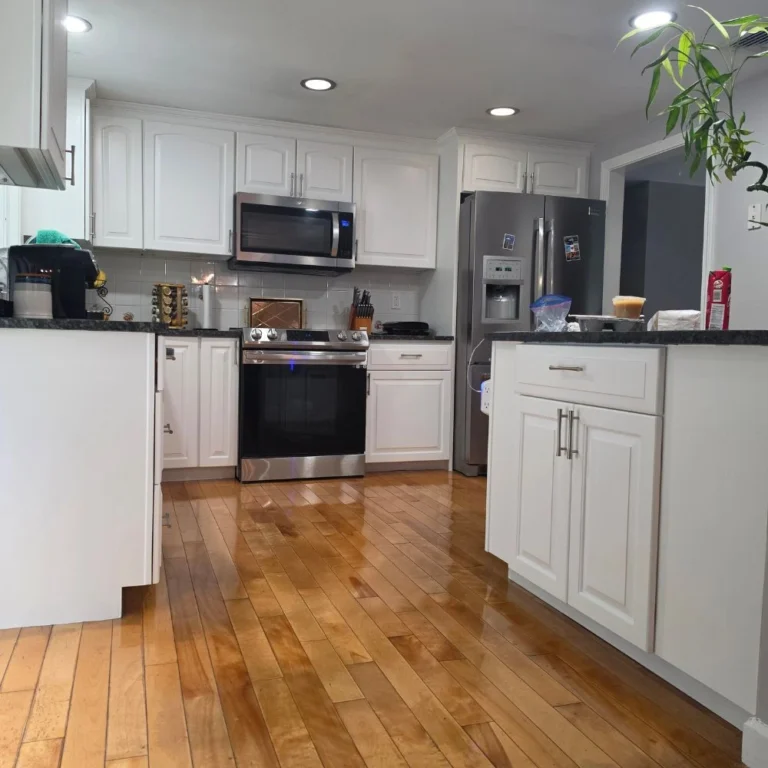
Yes. Many kitchen cabinets can be repainted without sanding the entire surface down to bare wood. The most important requirements are a clean substrate, a stable existing finish, suitable primer when needed and a topcoat that can withstand regular kitchen use.
Sanding traditionally helps remove loose coating, smooth imperfections and create a surface that new paint can grip. However, some modern bonding primers are formulated to adhere to difficult surfaces with minimal or no sanding when the manufacturer’s preparation instructions are followed. This makes a lower dust cabinet repaint possible in many homes. It does not eliminate every preparation step.
When a no sanding approach can work
You may be able to skip routine sanding when:
- The existing paint or clear coat is firmly attached.
- The surface is free from cooking grease, wax, polish and cleaning product residue.
- The cabinet doors are structurally sound and have no significant peeling or blistering.
- The selected primer is approved for the existing material and finish.
- The primer and topcoat are compatible and applied within their specified recoat windows.
A cabinet door with an intact painted finish may need thorough cleaning, light surface preparation if required and a suitable cabinet enamel. A glossy varnished door may need a different primer because its smooth surface presents a greater adhesion challenge.
When skipping sanding is a bad idea
A no sanding method is less suitable when the existing coating is flaking, cracked, chalky or poorly bonded. Applying new paint over a failing finish does not repair the underlying problem.
You may also need sanding or other mechanical preparation to remove raised grain, rough repairs, old drips, damaged coating edges or an uneven finish. Water damaged cabinet materials may need repair or replacement rather than another coat of paint.
A practical rule: If the old finish is sound, focus on cleaning and adhesion. If the finish is failing, address the failure before applying anything new.
What Is Best Paint for Kitchen Cabinets Without Sanding?
For most homeowners, the best choice is a cabinet specific enamel used over a compatible bonding primer. This combination addresses two separate needs: the primer helps the new coating adhere to the existing surface, while the enamel provides the finished color, sheen and protective film.
There is no single paint that works equally well on every cabinet. The best option depends on whether the doors are painted wood, stained oak, varnished maple, MDF, thermofoil or laminate.
Cabinet paint vs bonding primer vs ordinary wall paint
These products serve different purposes.
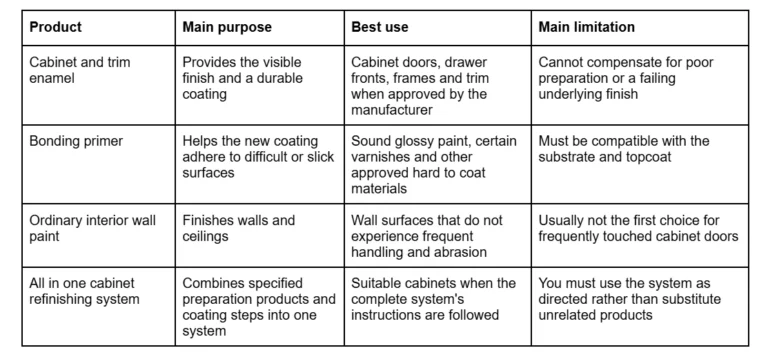
A bonding primer is particularly important when you want to avoid sanding. For example, Sherwin Williams describes its Extreme Bond Primer as suitable for many clean, paintable, hard to coat surfaces, with sanding potentially unnecessary in many cases. The manufacturer still emphasizes proper surface preparation and recommends testing adhesion before proceeding.
What to look for in cabinet paint
When comparing paints, look beyond the color name or the words kitchen and bath on the label. Check for these qualities:
- Durability: The finish should withstand frequent handling, routine cleaning and contact with kitchen items.
- Washability: Cabinet doors collect fingerprints, food splashes and grease. The coating should tolerate cleaning according to its care instructions.
- Leveling: Paint that levels well can reduce visible brush marks and roller texture.
- Adhesion compatibility: The finish must be approved for the selected primer and intended substrate.
- Recoat and cure requirements: A coating that feels dry quickly may still need several days or longer to develop its intended hardness.
For most painted kitchen cabinets, a satin or semi gloss cabinet enamel is a practical starting point. Satin has a softer appearance and can help make minor surface imperfections less conspicuous. Semi gloss reflects more light and is often easier to wipe clean, but it can also highlight dents, uneven repairs and application marks.
Neither sheen guarantees durability on its own. The quality of the coating, preparation, application and curing all matter.
Best Paint Options and Bonding Primers
The following options represent different approaches rather than a universal ranking. Product availability and formulations can change, so verify the current label and technical data sheet before purchasing.
1. Sherwin Williams Extreme Bond Primer with a compatible cabinet enamel
Extreme Bond Primer is formulated for adhesion to many hard to coat surfaces. That makes it worth considering for sound, previously finished cabinets when the product’s current instructions permit the specific substrate.
Its main advantage is that it may allow you to avoid sanding a clean, paintable surface. That does not mean you can coat greasy doors or paint over loose varnish. The primer must still be applied to a properly prepared surface.
Advantages
- May eliminate sanding on suitable, properly prepared surfaces.
- Can help the finish coat adhere to difficult substrates.
- It is intended to work with compatible finish coats.
Limitations
- It is a primer, so a suitable cabinet finish is still needed.
- It is not automatically appropriate for every plastic laminate, thermofoil or damaged surface.
- The manufacturer recommends testing adhesion before coating the full project.
For a homeowner trying to reduce sanding, this is a reasonable starting point when the existing cabinet finish is intact and the product’s technical instructions support the application.
2. Benjamin Moore ADVANCE Interior Paint
ADVANCE is a waterborne alkyd coating commonly used for interior trim and cabinetry. It is worth considering when a smooth, refined finish is a priority.
However, ADVANCE is not a substitute for a bonding primer when the existing finish requires one. Benjamin Moore’s technical data sheet specifies surface preparation requirements, including sanding glossy alkyd coatings. The correct preparation therefore depends on the surface you have, not simply the paint you buy.
Advantages
- Suitable for cabinetry and trim applications when the surface is properly prepared.
- Can produce a smooth appearance with careful application.
- Available in multiple finishes.
Limitations
- Recoat times can be longer than those of some waterborne coatings.
- Full hardness develops over time.
- Glossy existing alkyd finishes may require sanding, even if your goal is to avoid it.
Choose this option when product’s preparation requirements fit your cabinets and you can allow sufficient drying and curing time.
3. A dedicated cabinet refinishing system
A dedicated cabinet refinishing system can be an alternative to buying a separate primer and paint. Rust Oleum’s Cabinet Transformations instructions describe a preparation process that uses a supplied deglosser and scrub pads instead of conventional sanding or priming for the specified system.
The important distinction is that no sanding does not mean no preparation. The system still requires careful cleaning and completion of its prescribed steps. Its instructions also call for sanding repaired cracks, holes and gouges smooth before continuing.
Advantages
- Provides a defined preparation and coating process.
- Can reduce the need for conventional sanding on eligible surfaces.
- May simplify product selection because the components are intended to work together.
Limitations
- You must follow the specific system instructions.
- It may offer different finish and color options from a standalone cabinet enamel.
- It is not a remedy for structurally damaged or poorly bonded cabinet material.
Before buying a kit, check that the current version is intended for your cabinet material and existing finish.
4. Other cabinet and trim enamels
Many paint manufacturers offer waterborne acrylic, urethane modified or alkyd cabinet and trim coatings. These can be suitable choices when paired with the correct preparation and primer.
Do not assume that every product described as enamel is interchangeable. Enamel is a broad coating term, not a guarantee of a particular formulation, adhesion level or cure time.
Read the product’s technical data sheet to determine whether it is intended for cabinets, what primers it accepts, and how long it needs before normal use. When a product does not explicitly support the surface in question, ask the manufacturer or a paint specialist before applying it.